Publications
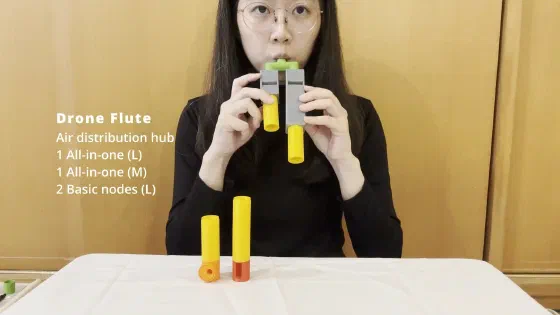
28. FlueBricks: A Construction Kit of Flute-like Instruments for Acoustic Reasoning
Proceedings of the 2026 CHI Conference on Human Factors in Computing Systems, 2026
We present FlueBricks, a construction kit for acoustic reasoning via building and customizing flute-like instruments. By assembling generator, resonator, and connector modules that embody various aeroacoustic properties, users gain deeper understanding of how blowhole, tube length, and tone-hole placement alter onset, …
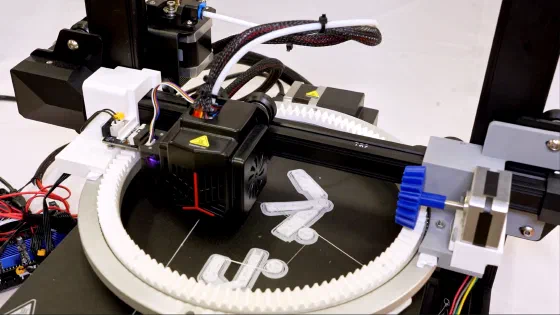
27. Rhapso: Automatically Embedding Fiber Materials into 3D Prints for Enhanced Interactivity
Proceedings of the 37th Annual ACM Symposium on User Interface Software and Technology, 2024
We introduce Rhapso, a 3D printing system designed to embed a diverse range of continuous fiber materials within 3D objects during the printing process. This approach enables integrating properties like tensile strength, force storage and transmission, or aesthetic and tactile characteristics, directly into low-cost …
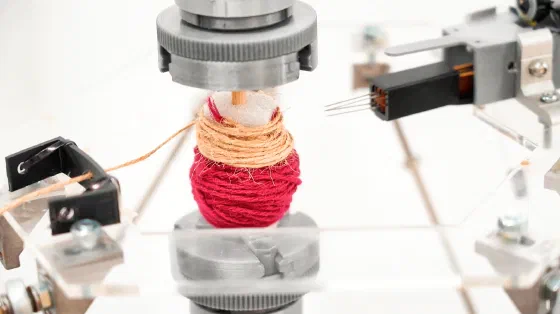
26. FeltingReel: Density Varying Soft Fabrication with Reeling and Felting
The 9th Annual Conference of Taiwanese Association of Computer-Human Interaction, 2023
FeltingReel is a soft fabrication system that allows users to create a 3D non-woven textile with various structural strengths. Our system coils wool yarn onto a central reel to form a basic shape and uses actuated barbed needles to refine it. By controlling the coiling tension and the felting times, our system varies …
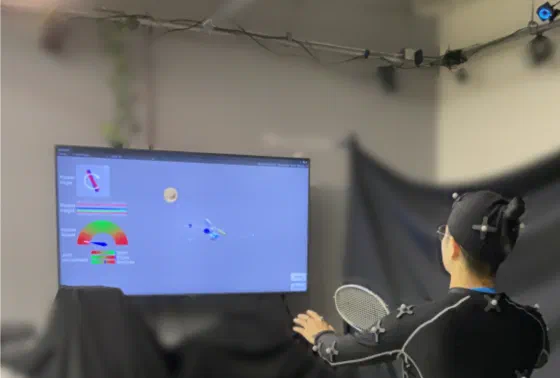
25. BetterMinton Service: Analyzing the Badminton Service using Open Kinetic Chain
The 9th Annual Conference of Taiwanese Association of Computer-Human Interaction, 2023
We present a badminton training system that focuses on the backhand short service. Unlike the prior motor skill training systems which focus on the trainee's posture, our system analyzes the process of moving joints with the open kinetic chain (OKC), which helps align movement and minimize muscle use for better joint …
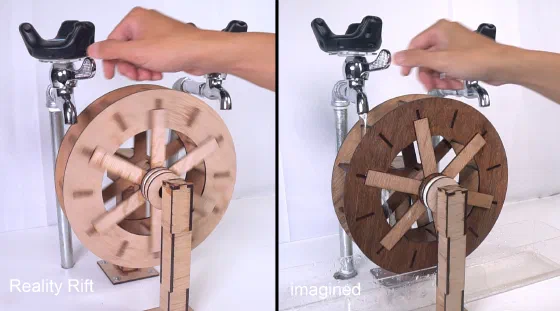
24. Reality Rifts: Wonder-ful Interfaces by Disrupting Perceptual Causality
Proceedings of the 2023 CHI Conference on Human Factors in Computing Systems, 2023
Reality Rifts are interfaces between the physical and the virtual reality, where incoherent observations of physical behavior lead users to imagine comprehensive and plausible end-to-end dynamics. Reality Rifts emerge in interactive physical systems that lack one or more components that are central to their operation, …
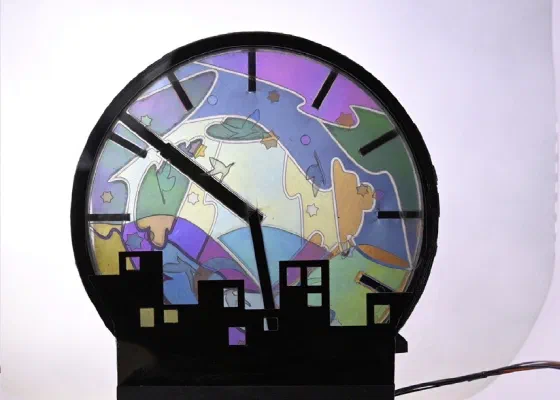
23. Polagons: Designing and Fabricating Polarized Light Mosaics with User-Defined Color-Changing Behaviors
Proceedings of the 2023 CHI Conference on Human Factors in Computing Systems, 2023
Polarized light mosaics (PLMs) are color-changing structures that alter their appearance based on the orientation of incident polarized light. While a few artists have developed techniques for crafting PLMs by hand, the underlying material properties are difficult to reason about; there exist no tools to bridge the …
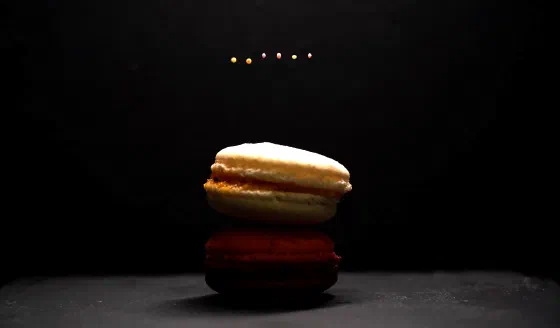
22. Garnish into Thin Air
Adjunct Proceedings of the 35th Annual ACM Symposium on User Interface Software and Technology, 2022
We propose Garnish into Thin Air, dynamic and three-dimensional food presentation with acoustic levitation. In contrast to traditional plating on the dishes, we make the whole garnishing process an interactive experience to stimulate users’ appetite by leveraging acoustic levitation’s capacity to decorate edibles …
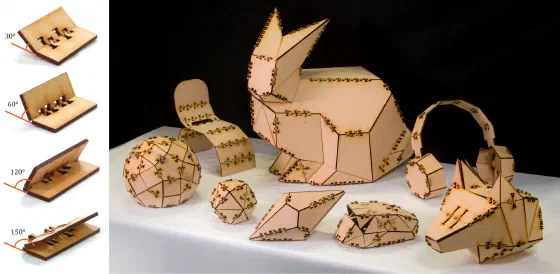
21. Flaticulation: Laser Cutting Joints with Articulated Angles
Proceedings of the 35th Annual ACM Symposium on User Interface Software and Technology, 2022
We present Flaticulation, a method to laser cut joints that clutch two cut-in-place flat boards at designated articulated angles. We discover special T-patterns added on the shared edge of two pieces allowing them to be clutched at a bending angle. We analyze the structure and propose a parametric model regarding the …
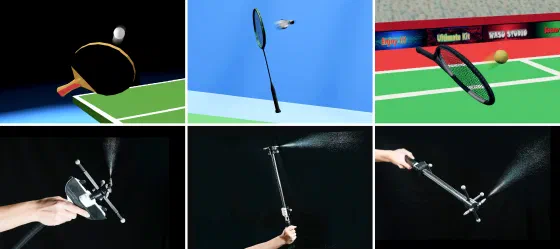
20. AirRacket: Perceptual Design of Ungrounded, Directional Force Feedback to Improve Virtual Racket Sports Experiences
Proceedings of the 2022 CHI Conference on Human Factors in Computing Systems, 2022
We present AirRacket, perceptual modeling and design of ungrounded, directional force feedback for virtual racket sports. Using compressed air propulsion jets to provide directional impact forces, we iteratively designed for three popular sports that span a wide range of force magnitudes: ping-pong, badminton, and …
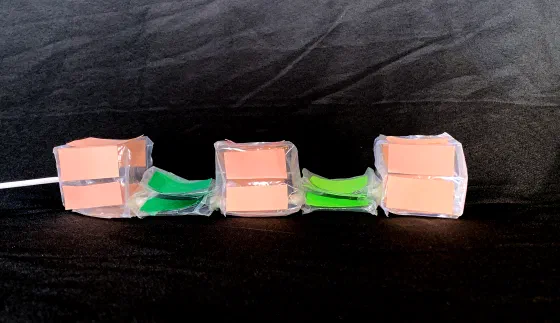
19. PneuSeries: 3D Shape Forming with Modularized Serial-Connected Inflatables
The 34th Annual ACM Symposium on User Interface Software and Technology, 2021
We present PneuSeries, a series of modularized inflatables where their inflation and deflation are propagated in-between stage by stage to form various shapes. The key component of PneuSeries is the bidirectional check valve that passively regulates the air flowing in/out from/to adjacent inflatables, allowing each of …
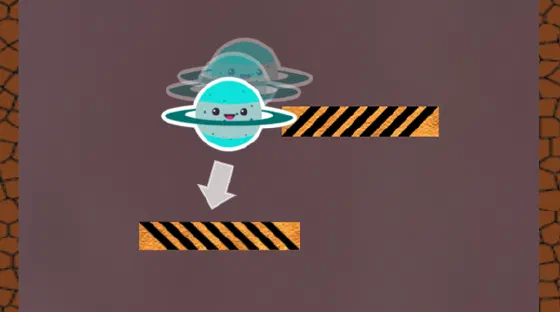
18. Game Illusionization: A Workflow for Applying Optical Illusions to Video Games
The 34th Annual ACM Symposium on User Interface Software and Technology, 2021
Optical illusions have been brought into recent video games to enhance gaming experiences. However, a large corpus of optical illusions remains unused, while few games incorporate illusions seamlessly. To mitigate the gap, we propose a workflow to guide game designers in applying optical illusions to their video games, …
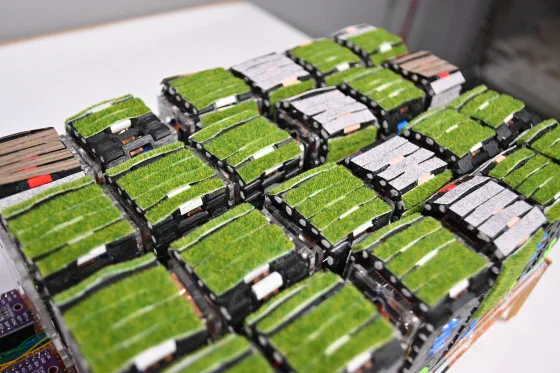
17. TexelBlocks: Dynamic Surfaces for Physical Interactions
Extended Abstracts of the 2021 CHI Conference on Human Factors in Computing Systems, 2021
We present TexelBlocks, modular blocks that dynamically change their surfaces to support rich physical interactions. The core component of each block is a motorized crawler belt with a set of material patches attached to it, allowing each of the TexelBlocks to change their surface independently and be concatenated into …
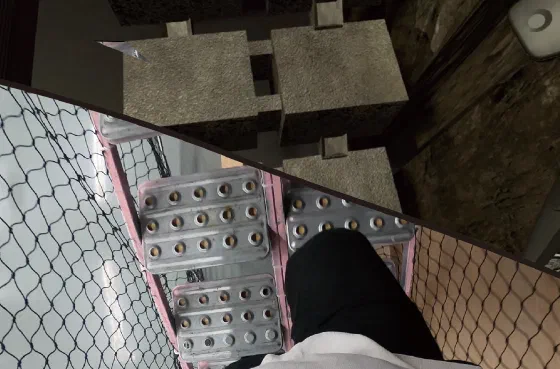
16. Impossible Staircase: Vertically Real Walking in an Infinite Virtual Tower
2021 IEEE Virtual Reality and 3D User Interfaces (VR), 2021
We present Impossible Staircase, a real-walking virtual reality system that allows users to climb an infinite virtual tower. Our set-up consists of an one-level scaffold and a lifter. A user climbs up the scaffold by real walking on a stairway while wearing a head-mounted display, and gets reset to the ground level by …
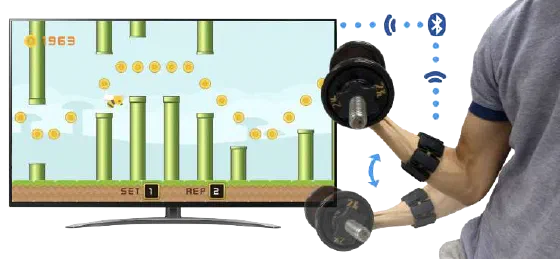
15. StrengthGaming: Enabling Dynamic Repetition Tempo in Strength Training-based Exergame Design
22nd International Conference on Human-Computer Interaction with Mobile Devices and Services, 2020
Strength training improves overall health, well-being, physical appearance, and sports performance, with training programs specifying variables such as sets, repetitions, rest time, weight, and tempo. The repetitive nature of strength training, typically performed at fixed tempo, has made it challenging to develop …
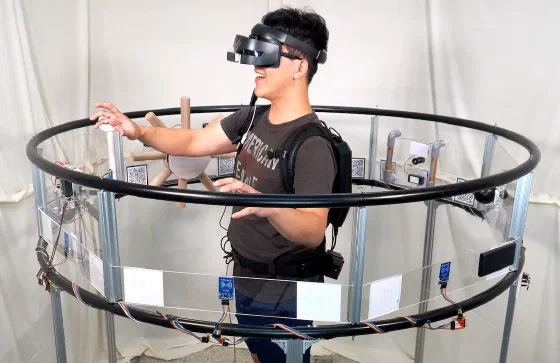
14. Haptic-go-round: A Surrounding Platform for Encounter-type Haptics in Virtual Reality Experiences
Proceedings of the 2020 CHI Conference on Human Factors in Computing Systems, 2020
We present Haptic-go-round, a surrounding platform that allows deploying props and devices to provide haptic feedbacks in any direction in virtual reality experiences. The key component of Haptic-go-round is a motorized turntable that rotates the correct haptic device to the right direction at the right time to match …
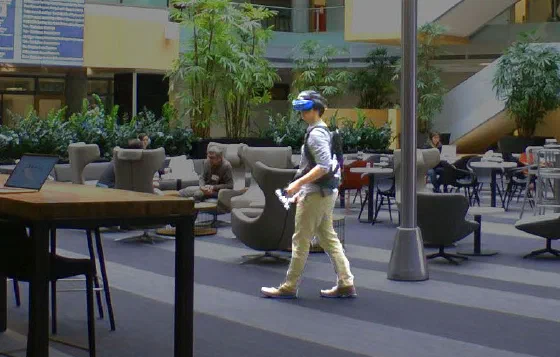
13. VRoamer: Generating On-The-Fly VR Experiences While Walking inside Large, Unknown Real-World Building Environments
2019 IEEE Conference on Virtual Reality and 3D User Interfaces (VR), 2019
Procedural generation in virtual reality (VR) has been used to adapt the virtual world to various indoor environments, fitting different geometries and interiors with virtual environments. However, such applications require that the physical environment be known or pre-scanned prior to use to then generate the …
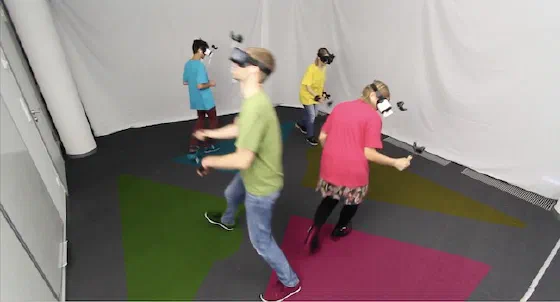
12. VirtualSpace - Overloading Physical Space with Multiple Virtual Reality Users
Proceedings of the 2018 CHI Conference on Human Factors in Computing Systems, 2018
Although virtual reality hardware is now widely available, the uptake of real walking is hindered by the fact that it requires often impractically large amounts of physical space. To address this, we present VirtualSpace, a novel system that allows overloading multiple users immersed in different VR experiences into …
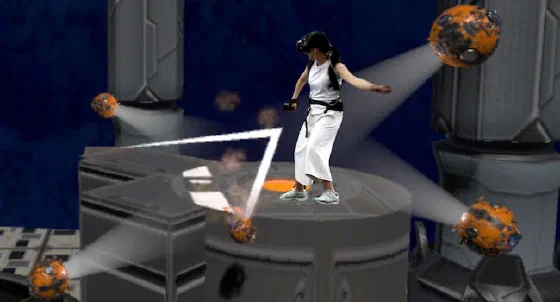
11. iTurk: Turning Passive Haptics into Active Haptics by Making Users Reconfigure Props in Virtual Reality
Proceedings of the 2018 CHI Conference on Human Factors in Computing Systems, 2018
We present a system that complements virtual reality experiences with passive props, yet still allows modifying the virtual world at runtime. The main contribution of our system is that it does not require any actuators; instead, our system employs the user to reconfigure and actuate otherwise passive props. We …
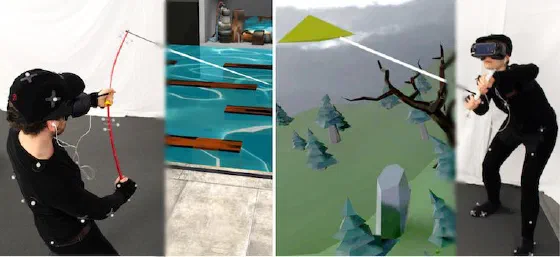
10. Mutual Human Actuation
Proceedings of the 30th Annual ACM Symposium on User Interface Software and Technology, 2017
Human actuation is the idea of using people to provide large-scale force feedback to users. The Haptic Turk system, for example, used four human actuators to lift and push a virtual reality user; TurkDeck used ten human actuators to place and animate props for a single user. While the experience of human actuators was …
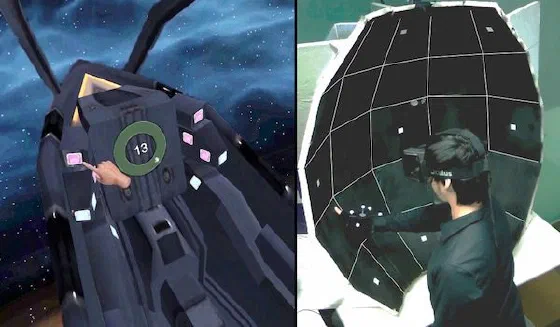
9. Sparse Haptic Proxy: Touch Feedback in Virtual Environments Using a General Passive Prop
Proceedings of the 2017 CHI Conference on Human Factors in Computing Systems, 2017
We propose a class of passive haptics that we call Sparse Haptic Proxy: a set of geometric primitives that simulate touch feedback in elaborate virtual reality scenes. Unlike previous passive haptics that replicate the virtual environment in physical space, a Sparse Haptic Proxy simulates a scene's detailed geometry by …
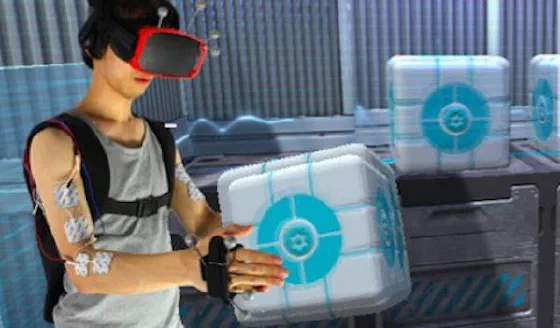
8. Providing Haptics to Walls & Heavy Objects in Virtual Reality by Means of Electrical Muscle Stimulation
Proceedings of the 2017 CHI Conference on Human Factors in Computing Systems, 2017
We explore how to add haptics to walls and other heavy objects in virtual reality. When a user tries to push such an object, our system actuates the user's shoulder, arm, and wrist muscles by means of electrical muscle stimulation, creating a counter force that pulls the user's arm backwards. Our device accomplishes …
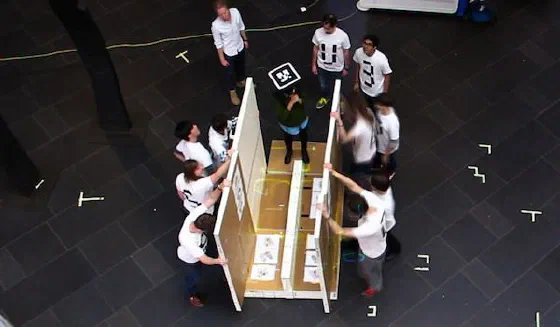
7. TurkDeck: Physical Virtual Reality Based on People
Proceedings of the 28th Annual ACM Symposium on User Interface Software & Technology, 2015
TurkDeck is an immersive virtual reality system that reproduces not only what users see and hear, but also what users feel. TurkDeck produces the haptic sensation using props, i.e., when users touch or manipulate an object in the virtual world, they simultaneously also touch or manipulate a corresponding object in the …
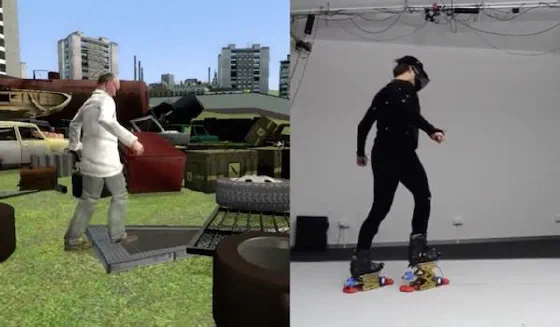
6. Level-Ups: Motorized Stilts that Simulate Stair Steps in Virtual Reality
Proceedings of the 33rd Annual ACM Conference on Human Factors in Computing Systems, 2015
We present \"Level-Ups\", computer-controlled stilts that allow virtual reality users to experience walking up and down steps. Each Level-Up unit is a self-contained device worn like a boot. Its main functional element is a vertical actuation mechanism mounted to the bottom of the boot that extends vertically. Unlike …
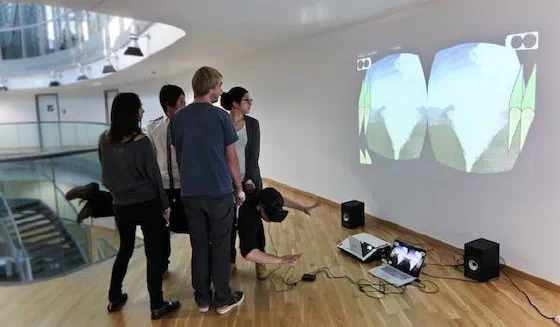
5. Haptic turk: a motion platform based on people
Proceedings of the SIGCHI Conference on Human Factors in Computing Systems, 2014
Motion platforms are used to increase the realism of virtual interaction. Unfortunately, their size and weight is proportional to the size of what they actuate. We present haptic turk, a different approach to motion platforms that is light and mobile. The key idea is to replace motors and mechanical components with …
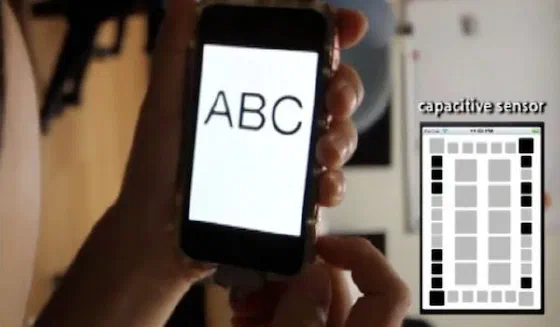
4. IrotateGrasp: automatic screen rotation based on grasp of mobile devices
Proceedings of the SIGCHI Conference on Human Factors in Computing Systems, 2013
Automatic screen rotation improves viewing experience and usability of mobile devices, but current gravity-based approaches do not support postures such as lying on one side, and manual rotation switches require explicit user input. iRotateGrasp automatically rotates screens of mobile devices to match users' viewing …
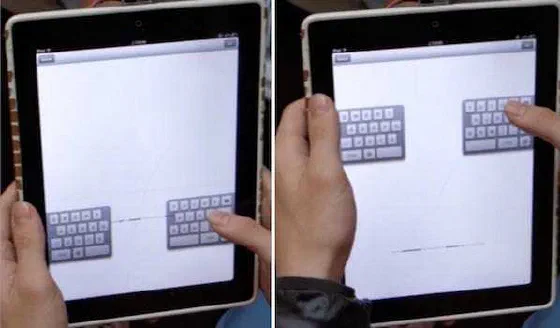
3. iGrasp: grasp-based adaptive keyboard for mobile devices
Proceedings of the SIGCHI Conference on Human Factors in Computing Systems, 2013
Multitouch tablets, such as iPad and Android tablets, support virtual keyboards for text entry. Our 64-user study shows that 98% of the users preferred different keyboard layouts and positions depending on how they were holding these devices. However, current tablets either do not allow keyboard adjustment or require …
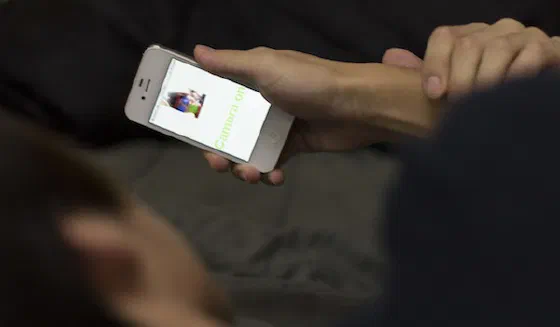
2. iRotate: automatic screen rotation based on face orientation
Proceedings of the SIGCHI Conference on Human Factors in Computing Systems, 2012
We present iRotate, an approach to automatically rotate screens on mobile devices to match users' face orientation. Current approaches to automatic screen rotation are based on gravity and device orientation. Our survey of 513 users shows that 42% currently experience auto-rotation that leads to incorrect viewing …
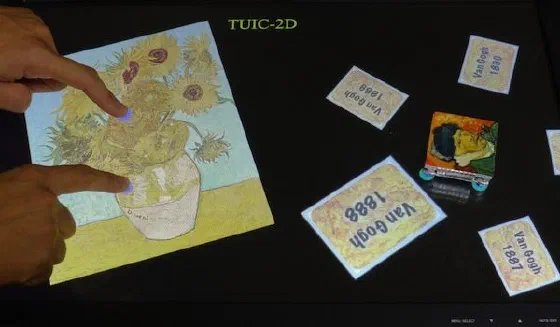
1. TUIC: enabling tangible interaction on capacitive multi-touch displays
Proceedings of the SIGCHI Conference on Human Factors in Computing Systems, 2011
We present TUIC, a technology that enables tangible interaction on capacitive multi-touch devices, such as iPad, iPhone, and 3M's multi-touch displays, without requiring any hardware modifications. TUIC simulates finger touches on capacitive displays using passive materials and active modulation circuits embedded …